GRASP
Vocal breathiness Field study 001
Plays a synthesized tone and aspiration noise shaped by the breath control. No microphone is used.
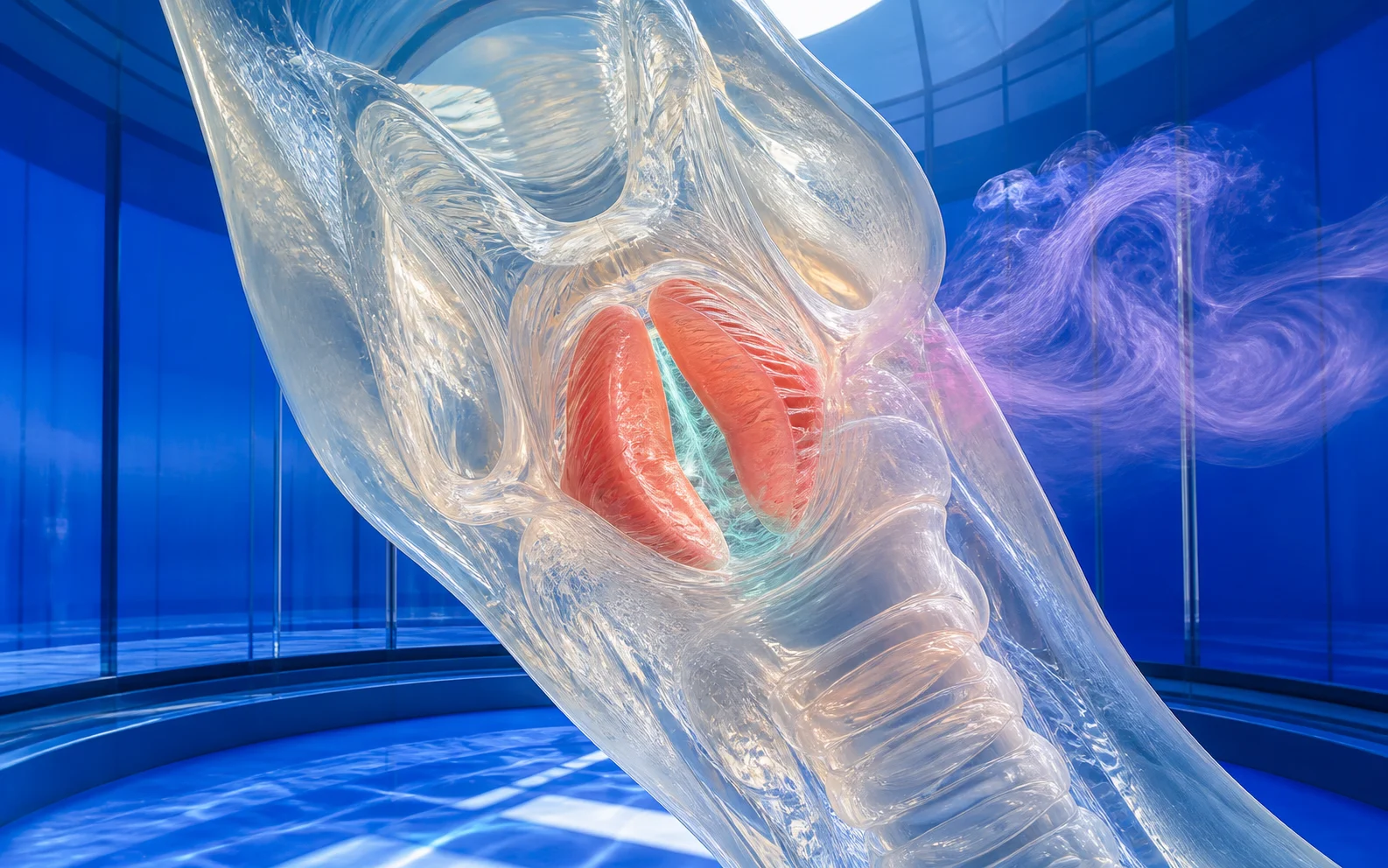
A monumental translucent glass larynx in a cobalt chamber, with coral vocal folds and turquoise breath becoming violet mist.

A five-layer journey into vocal breathiness

One opening changes everything you hear.

Move one physical gap. Watch anatomy become airflow, noise, harmonics, mathematics, and finally something you can use.

Balanced
Enter the instrument
InteractiveSound optional~7 minutes

The Grasp method

Not five lessons. One idea, seen five ways.

See the gate Hear tone meet air Watch the spectrum lean Find the hidden period Read a portrait, never a verdict
Balanced
1Intuition / anatomy

The gate

Air rises through the glottis, the space between your vocal folds. In voiced sound, the folds repeatedly open and return toward closure.

Two things shape the result: how long the folds stay open, and whether a gap remains at their closest point. A gap is a mechanism, not a diagnosis; normal voices vary widely.

OQ = topen / TOpen quotient · 0 to 1
Source · Chen et al., JASA 2013 ↗
2Concept / perception

Tone meets air

Breathy voice keeps a repeating tone, but threads it with aspiration noise. You hear both: ordered pulses from vibration and turbulence in the passing air.

It is not simply a quieter voice, and it is not the same as whisper. Move the breath lens or turn on sound: the harmonic ribbon remains while the noisy layer grows around it.

x(t) = p(t) + n(t)Periodic voice + aspiration noise
Source · Klatt & Klatt, JASA 1990 ↗
3Acoustics / measurement

The spectrum leans

Each repeating cycle lays down harmonics at f₀, 2f₀, 3f₀… In breathier production, energy often falls away faster toward the upper harmonics.

That lean is spectral tilt. H1−H2 compares the first two harmonic levels; H1−A3 reaches toward the third-formant region. Vowel, pitch, vocal tract, and speaker all matter.

H1 − H2 = L(H1) − L(H2)Illustrative difference · 8.0 dB
Source · Iseli, Shue & Alwan, JASA 2007 ↗
4Physics / model

The hidden period

Turn the spectrum inside out and a landmark appears. When cycles repeat clearly, their period rises above the cepstral background. Added noise softens that peak.

Cepstral peak prominence is one clue. The Acoustic Breathiness Index combines nine clues, but it remains a model of perceived sound, not a picture of your vocal folds.

CPP = C(q₀) − Ĉ(q₀)q₀ ≈ 1 / f₀ · here, 5 ms
Source · Hillenbrand et al., JSHR 1994 ↗
5Application / proof

Read a portrait

A microphone hears sound. It cannot see vocal-fold closure or measure airflow. This instrument reports acoustic observations, never anatomy, health, or a verdict.

Begin a deterministic simulated take. It translates the breath-lens state into a sound portrait, so you can prove you understand which clues move together and which claims remain impossible.

Prediction / if the aperture opens further, what should happen?

Commit to a causal prediction before the instrument reveals its portrait.

Periodic structureReady
H1 above H2— dB
CPP— dB

Illustrative simulation. No microphone is requested and no diagnostic inference is made.

Technical boundary · W3C Web Audio ↗

Proof of Grasp / journey complete

You don't finish a journey. You carry a model.

One opening now connects tissue, airflow, noise, harmonic balance, periodicity, and responsible measurement. That connected model, not a completion badge, is what comes home with you.

Return to the gate ↑

Open the source cabinet.

Grasp journeys expose their evidence. These primary sources shaped this illustrative path; the interface simplifies them without pretending the uncertainty disappeared.

  1. L01Glottal area, open quotient, and voice quality↗
  2. L02Analysis, synthesis, and perception of voice quality↗
  3. L03Voice source measures and spectral correction↗
  4. L04Acoustic correlates of breathy vocal quality↗
  5. L05What a browser audio analyser actually provides↗